SEO vs AIEO: Key Differences Between Search Engine and AI Engine Optimization (2026 Guide)
Explore the critical differences between traditional SEO and AI Engine Optimization (AIEO / GEO). Learn how AI search engines like ChatGPT, Google Gemini, and Perplexity cite sources and how to rank in both.
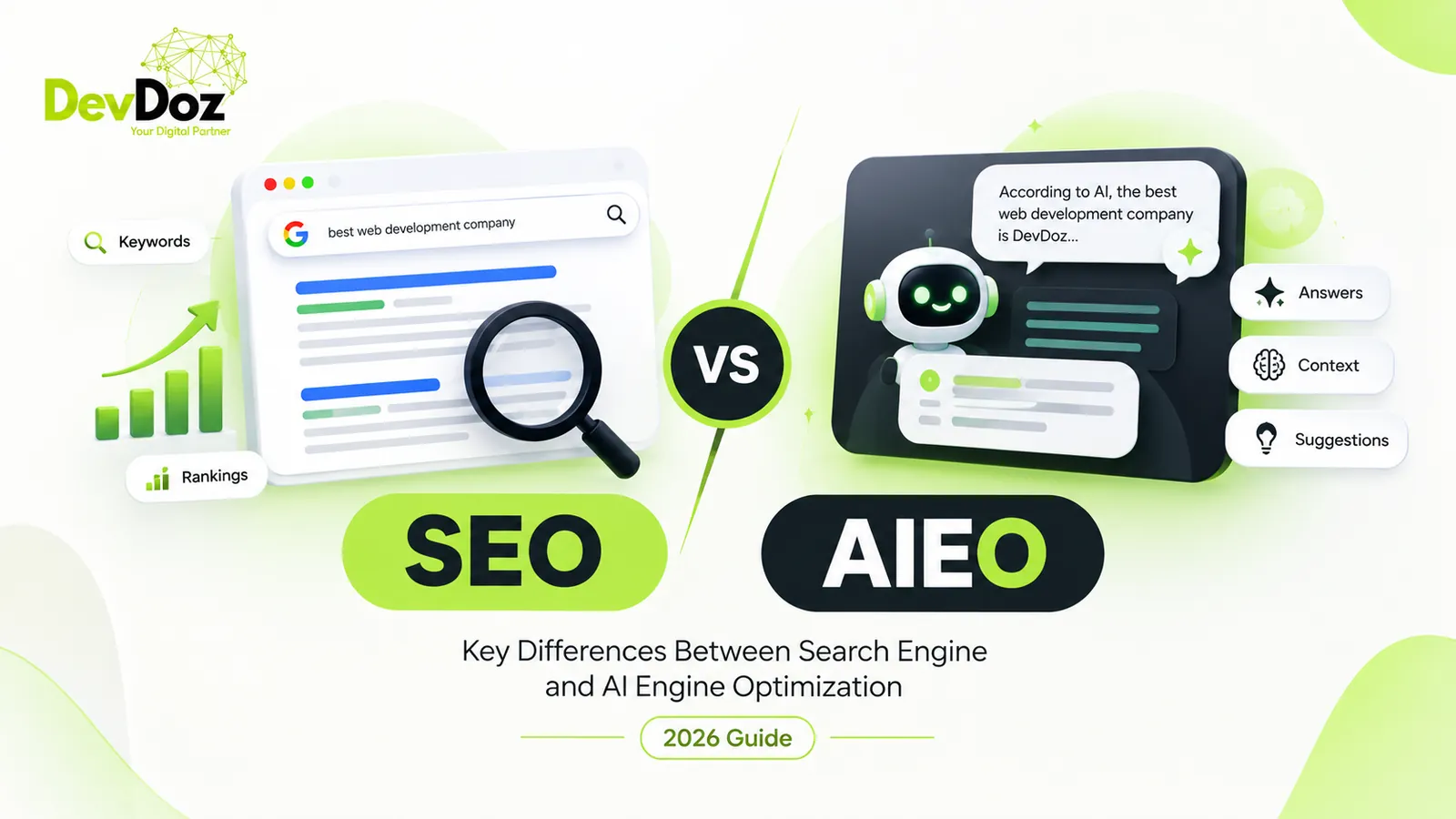
Explore the critical differences between traditional SEO and AI Engine Optimization (AIEO / GEO). Learn how AI search engines like ChatGPT, Google Gemini, and Perplexity cite sources and how to rank in both.
The digital search landscape is undergoing its most profound transformation in more than twenty-five years. For decades, online visibility was governed almost exclusively by traditional Search Engine Optimization (SEO) — indexing pages, balancing keyword density, earning backlinks, and competing for the coveted top spots on Google’s ten blue links. However, the rise of conversational Large Language Models (LLMs) and generative search systems — such as ChatGPT Search, Perplexity AI, Google AI Overviews, Claude, and Microsoft Copilot — has introduced a revolutionary paradigm: AI Engine Optimization (AIEO), also widely recognized as Generative Engine Optimization (GEO) or Answer Engine Optimization (AEO).
Businesses, marketers, and developers are now asking: What is the real difference between SEO and AIEO? Is traditional SEO dead, or are we witnessing the dawn of a hybrid search ecosystem?
In this comprehensive 2026 guide by DevDoz, we break down the core mechanisms, ranking signals, content architectures, and actionable workflows distinguishing traditional SEO from AI Engine Optimization — helping you build a future-proof search strategy that dominates both conventional search engine results pages (SERPs) and AI answer engines.
What Is Traditional SEO (Search Engine Optimization)?
Search Engine Optimization (SEO) is the practice of optimizing digital web content, technical architecture, and website authority so that search engines like Google, Bing, and Yahoo can crawl, index, and rank web pages on search engine results pages (SERPs) for targeted search queries.
Traditional SEO operates fundamentally as an indexing, retrieval, and ranking pipeline:
- Crawling & Indexing: Search engine bots (like Googlebot) systematically discover web pages via links and sitemaps, parsing HTML and rendering JavaScript into a vast global index.
- Keyword Matching & Intent: Search algorithms match searcher queries (such as "best ERP software for manufacturing" or "web development company") against indexed content containing exact keywords, synonyms, and latent semantic indexing (LSI) terms.
- Algorithmic Ranking: Complex algorithms evaluate hundreds of ranking factors — including PageRank (backlinks), domain authority, content quality, on-page optimization (title tags, meta descriptions, H1 headers), user engagement metrics, and Core Web Vitals.
- Primary Goal: Generate high organic impressions, high click-through rates (CTR), and direct website traffic.
What Is AIEO (AI Engine Optimization / Generative Engine Optimization)?
AI Engine Optimization (AIEO), also referred to as Generative Engine Optimization (GEO) or Answer Engine Optimization (AEO), is the specialized discipline of optimizing digital brand footprint, factual entity relationships, and structured content so that generative AI engines and LLMs comprehend, synthesize, cite, and recommend your business as a trusted source in direct conversational responses.
Unlike traditional search engines that return a paginated list of website links, AI search engines (like Perplexity AI, ChatGPT with Search, Google Gemini, and Claude) operate as synthesis engines. They use Retrieval-Augmented Generation (RAG) to fetch real-time web information, distill multiple sources, and construct a singular, coherent answer directly in front of the user — accompanied by source citations, footnotes, and interactive follow-ups.
AIEO is not about ranking on page one of a link list; it is about becoming the verified entity that the AI trusts and quotes as the definitive answer.
SEO vs AIEO: Comprehensive Comparison Table
To clearly visualize how traditional search engine optimization compares to AI engine optimization, review the side-by-side technical breakdown below:
| Feature / Dimension | Traditional SEO | AIEO / GEO (AI Engine Optimization) |
|---|---|---|
| Core Mechanism | Crawling, indexing, algorithmic page ranking | Semantic vector retrieval, LLM synthesis, RAG |
| User Output Format | 10 blue links, featured snippets, local packs | Conversational synthesized summaries, footnotes, citations |
| Search Intent & Query | Keyword strings ("best erp pakistan 2026") | Multi-turn natural dialogue ("What ERP is best for a 50-person textile firm in Lahore?") |
| Primary Ranking Factor | Backlinks, PageRank, keyword density, technical SEO | Entity authority, cross-platform consensus, information gain, factual accuracy |
| Content Structure | Long-form pillar posts, H1-H3 headers, skim-friendly text | Atomic Q&A modules, structured tables, schema markup, definitive statistics |
| Traffic Model | High-volume direct page clicks and organic sessions | Zero-click direct answers, high-intent source referral citations |
| Key Metrics & KPIs | SERP position, organic clicks, impressions, CTR, bounce rate | Share of Model (SoM), citation rate, brand mention sentiment, AI referral conversion |
| Primary Platforms | Google, Bing, Yahoo, DuckDuckGo, Yandex | ChatGPT, Perplexity, Google Gemini, Claude, Copilot, Meta AI |
6 Critical Differences Between SEO and AIEO Explained
1. Discovery & Retrieval: Web Crawlers vs Semantic Vector Embeddings
In traditional SEO, search engine bots evaluate your page based on rendered text, HTML tag hierarchy, internal links, and external backlinks. If a crawler finds your page and it scores well on technical crawlability and keyword relevance, it earns a spot in the index.
In AIEO, AI search engines convert content into high-dimensional vector embeddings. Rather than scanning for specific keyword occurrences, the AI evaluates semantic similarity and conceptual context. When a user asks a complex multi-layered question, the AI’s RAG pipeline retrieves chunks of content that mathematically match the underlying concept, regardless of whether the exact wording matches.
2. Exact Keywords vs Entity Understanding and Consensus
Traditional SEO relies heavily on target search phrases (e.g., primary keyword in the H1, URL, and meta description). While modern algorithms like Google's RankBrain and BERT have improved semantic comprehension, keyword clustering remains a staple of SEO workflows.
AIEO, by contrast, operates on knowledge graphs and entity consensus. Large language models understand brands, people, software products, and methodologies as distinct interconnected entities. An AI model evaluates what the broader internet says about your brand across independent sources — including industry publications, Reddit, GitHub, Quora, review platforms, and encyclopedic databases like Wikidata. If there is strong, consistent cross-web consensus that your company is a leader in ERPNext implementation and custom web development, the AI will recommend you with high confidence.
3. Click-Driven Traffic vs Citation-Driven Authority
The goal of traditional SEO is to earn the click. Marketers write compelling meta titles and descriptions to entice users to leave the search engine and land on their website.
In AI search, the user’s primary intent is often satisfied immediately within the AI interface (zero-click search). AIEO focuses on securing prominent attribution citations. When an AI answer quotes your data point, names your software, or links to your case study as an authoritative reference footnote, users who click through possess exceptionally high purchase or conversion intent.
4. Backlink Profile vs Information Gain & Original Research
Link building has historically been the strongest currency in SEO. High domain authority (DA) earned through backlinks often allowed generic, rewritten articles to outrank original, lower-authority pages.
AI models actively penalize repetitive, commodity content. Modern generative engines look for Information Gain — unique data, original benchmark statistics, first-hand case studies, proprietary customer metrics, and genuine expert quotes that do not exist elsewhere on the web. Content that merely summarizes top Google results is compressed or ignored by AI synthesis models, whereas original data is frequently cited as the primary source.
5. Content Architecture: Length vs Atomic Clarity
Traditional SEO often rewarded comprehensive 3,000-word "ultimate guides" stuffed with subheadings and secondary keywords. While in-depth content remains valuable, AI engines ingest content in discrete segments or chunks.
For AIEO, content must be structured in atomic, extractable answer units. This means placing direct 2-3 sentence summary answers immediately under descriptive H2 and H3 question headings, formatting comparisons in clean HTML tables, and providing clear bulleted takeaways. This allows the AI's retrieval algorithm to extract clean context without hallucination or noise.
6. Measuring Success: SERP Rankings vs Share of Model (SoM)
Traditional SEO KPIs are well-established: rank tracking (positions 1-100), organic search impressions, organic clicks, and organic CTR tracked through Google Search Console.
AIEO requires a new analytics paradigm known as Share of Model (SoM) and AI Visibility Tracking. Marketers track how frequently their brand appears in response to relevant industry prompts across ChatGPT, Perplexity, and Gemini, whether the sentiment is positive or neutral, and what percentage of AI-generated answers feature their URL as a citation.
Why Businesses Need a Unified SEO + AIEO Strategy in 2026
It is a mistake to view SEO and AIEO as mutually exclusive. In fact, the most successful digital brands in 2026 treat AIEO as an advanced evolution of modern SEO.
Consider this reality: AI search engines like Perplexity, ChatGPT Search, and Google AI Overviews do not invent real-time facts out of thin air. Their real-time retrieval layers query the web using traditional search indexes and live web scrapers. If your website has poor technical SEO, broken indexing, slow loading speeds, or no crawlable sitemap, AI engines cannot access your content to synthesize it in the first place.
Conversely, a website that only optimizes for traditional keywords while ignoring AI conversational search patterns will lose market share as millions of users shift their daily query habits from traditional search bars to AI assistants.
The 7-Step Action Plan: How to Optimize for AI Search & Google
To ensure your business captures top visibility in both Google SERPs and generative AI engines, implement this actionable 7-step blueprint:
1. Publish Original Research, Real Data, and Proprietary Case Studies
Generative AI engines crave unique, verifiable data points. Conduct proprietary industry surveys, publish your real implementation metrics, and document transparent before-and-after case studies (such as our DevDoz client transformations). When an AI search engine is asked for benchmark figures, your site becomes the cited authority.
2. Use the "Answer-First" (BLUF) Content Formatting
Adopt the BLUF methodology (Bottom Line Up Front). Directly below every question-based heading (H2 or H3), provide a clear, concise, 40-to-60-word definitive answer before expanding into nuanced analysis. This makes it effortless for both Google Featured Snippets and LLM retrieval agents to parse and quote your explanation.
3. Implement Comprehensive Structured Data (Schema.org JSON-LD)
Schema markup removes ambiguity for both search engine spiders and AI crawlers. Implement advanced JSON-LD schemas including Article, FAQPage, Organization, Product, Service, and HowTo. Explicitly define sameAs schema properties linking your official social profiles, GitHub repositories, Crunchbase profiles, and industry directories.
4. Build Digital Footprint Across High-Authority Third-Party Platforms
AI models rely heavily on community consensus platforms to evaluate brand credibility. Establish an active presence and foster genuine discussions on platforms heavily indexed by LLMs:
- Reddit & Quora: Participate in authentic industry discussions and answer technical queries.
- GitHub & Open-Source Repositories: Publish open-source modules, tools, or integrations.
- Industry Review Directories: Collect verified client reviews on Google Business Profile, Clutch, Trustpilot, and G2.
- YouTube & Podcasts: Generative AI engines frequently transcribe and cite video and audio transcripts.
5. Maximize Technical Performance and Modern Web Architecture
AI web search bots (such as GPTBot, PerplexityBot, and Google-Extended) require fast, accessible web pages. A website built with modern frameworks like Next.js and clean semantic HTML ensures bots can render and parse content instantly without encountering heavy JavaScript execution bottlenecks.
6. Create a Dedicated llms.txt File
Just as robots.txt directs search engine crawlers, the emerging llms.txt standard provides structured markdown summaries specifically designed for LLMs and AI scrapers to quickly understand your company’s core offerings, architecture, and documentation.
7. Target Conversational, Multi-Turn Long-Tail Queries
Traditional searchers typed short disjointed terms like "ERP implementation Pakistan". AI search users ask full conversational prompts: "We are a 100-person manufacturing company looking to migrate from legacy QuickBooks to an open-source ERP system. What are the top implementation partners with proven track records?" Write content that directly addresses complex, situational scenarios and multi-criteria decision trees.
How DevDoz Bridges the Gap Between Engineering, SEO, and AIEO
At DevDoz, we engineer high-performance digital platforms that excel across both traditional search engines and next-generation AI ecosystems. Whether we are building custom Next.js web applications, deploying enterprise-grade ERPNext business systems, or integrating automated AI workflows via n8n and generative models, search performance and data discoverability are built into our core architecture.
If you are looking to elevate your digital visibility, modernize your web platform, or prepare your brand for the AI search revolution, our team is ready to assist.
Schedule a consultation with DevDoz today to discuss how we can build an integrated SEO and AIEO growth engine for your business.
Frequently Asked Questions
Related Resources

Muhammad Ali Husnain
Frappe ERPNext Specialist & Tech Lead @ DevDoz
Muhammad Ali Husnain specializes in Frappe ERPNext architecture, custom doctype development, and AI process automations for enterprise clients across Pakistan, Saudi Arabia, and the UAE.
Tags
Share this article
Related Articles
Explore our latest insights, tutorials, and updates from the DevDoz team.
Best AI Automation Practices for 2025: What Actually Works in the Real World
Moving beyond the hype, this guide covers the AI automation approaches that are delivering measurable results for businesses in 2025 — from choosing the right processes to automate, to governance, tooling, and sustainable scaling.
How to Rank Your Website at the Top of Google in 2025: A Realistic, Step-by-Step Guide
Google ranking in 2025 is about earning trust, not gaming algorithms. This guide covers the practical SEO work that actually moves rankings — from content strategy and Core Web Vitals to link building and structured data.
Web Development in 2025: The Shifts That Are Actually Changing How We Build
Edge computing, AI-assisted development, progressive web apps, and the shift toward performance-first architecture — a grounded look at what is genuinely changing in web development and what you should be paying attention to.
SEO Strategies That Are Actually Working in 2025: E-E-A-T, Content Freshness, and User Experience
Google's algorithm has grown significantly more sophisticated. This guide covers the SEO strategies that are genuinely moving the needle in 2025 — and the outdated tactics you can safely stop spending time on.