SEO Strategies That Are Actually Working in 2025: E-E-A-T, Content Freshness, and User Experience
Google's algorithm has grown significantly more sophisticated. This guide covers the SEO strategies that are genuinely moving the needle in 2025 — and the outdated tactics you can safely stop spending time on.
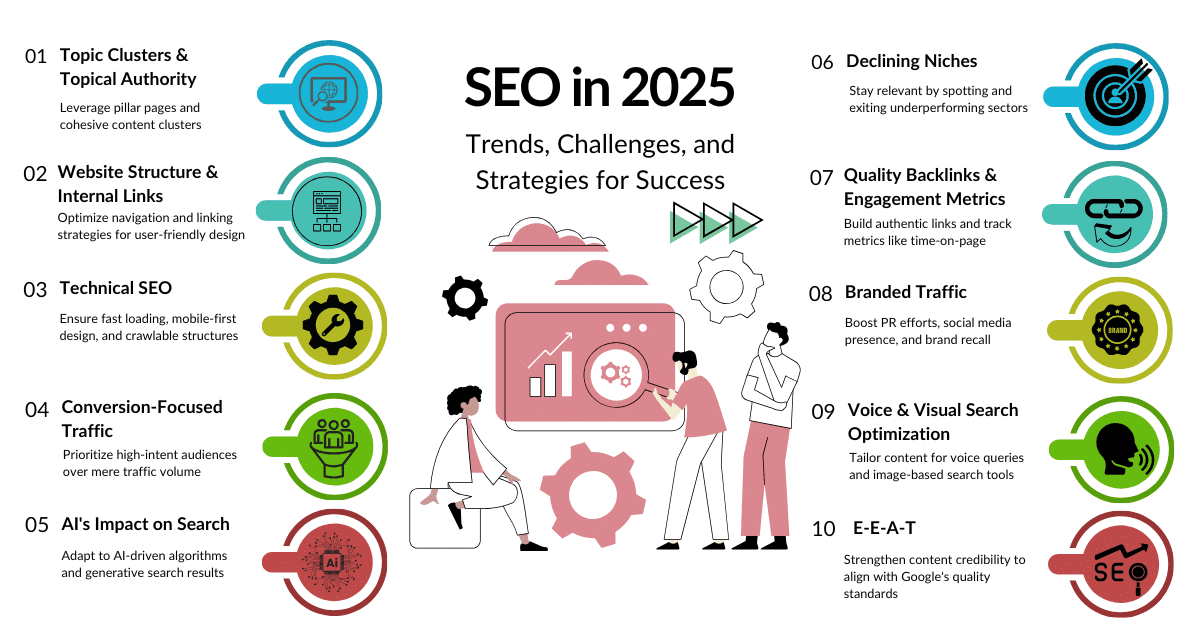
Google's algorithm has grown significantly more sophisticated. This guide covers the SEO strategies that are genuinely moving the needle in 2025 — and the outdated tactics you can safely stop spending time on.
The fundamentals of SEO have not changed as dramatically as the industry conversation sometimes suggests. The goal — produce content that genuinely serves users better than the alternatives — has always been the right one. What has changed is Google's ability to evaluate whether you are achieving it. Tactics that once worked because they manipulated signals Google could not yet read properly are now ineffective or actively harmful. The room for gaming the system has narrowed significantly, which is actually good news if you were planning to do it properly anyway.
This guide focuses on the strategies that are producing results in 2025, with a particular emphasis on E-E-A-T (Experience, Expertise, Authoritativeness, Trustworthiness), content freshness, and user experience — three areas where Google's evaluation has become markedly more sophisticated in recent years.
E-E-A-T: What It Actually Means and How to Demonstrate It
E-E-A-T is not a ranking factor in the sense that there is no "E-E-A-T score" that Google calculates and plugs into its algorithm. It is a framework that Google's quality raters use when evaluating content, and it reflects the kinds of signals that Google is trying to identify algorithmically. Understanding it is useful not as a checklist but as a way of thinking about what makes content credible.
Experience is the newest addition to what was previously E-A-T, and it refers to first-hand experience with the topic. A restaurant review written by someone who has eaten at the restaurant carries more weight than one assembled from other reviews. A guide to implementing ERPNext written by someone who has done dozens of implementations is more credible than one written from theoretical knowledge. Google is getting better at distinguishing these, and it is reflected in how consistently first-hand content outperforms purely synthesised content for competitive queries.
Expertise refers to the depth of knowledge demonstrated in the content. This is evaluated through the accuracy of claims, the appropriate use of technical terminology, the acknowledgment of nuance and complexity, and the avoidance of the kind of oversimplification that signals a surface-level understanding of a topic.
Authoritativeness is partly established through the reputation of the site and author — backlinks from respected sources, mentions in credible publications, and the general pattern of what others in the field think of your work. It is also established through the consistency and depth of your coverage of a topic over time. A site that has published twenty genuinely useful articles on ERPNext implementation is more authoritative on that topic than one that has published three, regardless of how good those three are.
Trustworthiness covers the basic signals of a legitimate, honest operation: clear authorship, transparent about who is behind the site, no deceptive practices, accurate information, and a site that does what it says it will do. For e-commerce and sites handling personal data, security (HTTPS, clear privacy policy) is particularly important.
The practical implication is that building genuine expertise and demonstrating it consistently over time is the most reliable path to strong E-E-A-T signals. There is no shortcut to this. A strong author bio helps. Real case studies and examples help. Being specific and accurate rather than vague and hedged helps. Keeping content current helps. None of these is surprising; all of them require sustained effort.
Content Freshness: When It Matters and When It Does Not
Google's freshness signals are real but often misunderstood. Freshness matters a great deal for queries where the answer changes over time — news, current events, product pricing, software documentation, and anything with a year in the search query. For these, recently published or recently updated content has a meaningful ranking advantage.
Freshness matters much less for evergreen content — topics where the best answer does not change significantly from year to year. A guide to double-entry bookkeeping principles does not need to be updated quarterly. A guide to ERPNext installation does, because the software changes.
The practical strategy is to identify which of your existing content has a freshness-sensitive nature and build a regular update schedule around it. When you update content, make meaningful changes — add new data, update outdated information, address questions that have appeared in the comments or in searches — rather than simply changing the date. Google has become much better at distinguishing genuine updates from cosmetic ones.
Topic clusters are also worth understanding in this context. Rather than treating each article as a standalone piece, building a network of related articles that link to each other and to a central "pillar" page on the topic tends to perform better than isolated content. It demonstrates topical authority — breadth and depth of coverage — in a way that a single article cannot.
User Experience as an SEO Signal
The integration of Core Web Vitals into Google's ranking algorithm formalised something that was already true in practice: if users have a poor experience on your site, your rankings will suffer. The formal signals Google measures are the three Core Web Vitals — LCP, CLS, and INP — but they are proxies for a broader user experience evaluation.
Beyond the measured vitals, think about what happens when a user arrives on your page from a search result. If they find what they were looking for quickly and do not immediately click back to the search results, that is a positive signal. If the page they land on is slow, cluttered, or does not answer their question, they will leave quickly — and a pattern of quick returns to search results is a negative signal that Google interprets as dissatisfaction.
Mobile experience deserves particular attention. The majority of searches now happen on mobile devices, and Google indexes the mobile version of your site. A page that is readable and navigable on a small screen, without requiring horizontal scrolling or zooming to read text, is the baseline expectation — not a bonus feature.
Reducing interstitials — pop-ups, overlays, and other interruptions that appear immediately when a user lands on a page — also matters. Google penalises pages that use intrusive interstitials on mobile, and beyond the ranking impact, they reliably reduce the quality of the user experience in ways that translate into worse engagement metrics.
Structured Data: Not Optional Anymore
Schema markup is code that tells search engines explicitly what your content is about, rather than leaving them to infer it from the text. Well-implemented schema can result in rich results — enhanced search listings that include star ratings, FAQ dropdowns, recipe cards, event dates, and other information that makes your listing more visible and more useful.
The most impactful schema types for most service-based businesses are Article (for blog posts and guides), FAQ (for pages with question-and-answer content), LocalBusiness (for businesses serving specific geographic areas), and BreadcrumbList (to show the site structure in search results). For e-commerce, Product and Review schema are particularly important.
Schema does not guarantee rich results — Google decides whether to show them based on a range of signals — but it increases the probability significantly, and the investment of time to implement it properly is modest relative to the potential visibility benefit.
For more on the technical implementation side of SEO, our post on how to rank your website on Google in 2025 covers the full technical foundation in detail.
What to Stop Doing
It is worth being explicit about what no longer works, because a significant amount of time and budget is still being spent on tactics that have been ineffective for years.
Keyword stuffing — inserting target keywords unnaturally throughout content to increase density — is actively harmful and has been for over a decade. Write naturally, use related terms and synonyms, and trust that Google's language understanding is sophisticated enough to recognise what your content is about without you repeating a phrase every three sentences.
Low-quality link building — purchasing links, participating in link schemes, spinning articles to post on low-authority directories — carries more risk than reward. The short-term gains are often followed by algorithmic or manual penalties, and the recovery process is painful. The investment is better spent on content that earns links naturally.
Thin content published primarily for keyword coverage, rather than because it genuinely serves a user need, is consistently being deprioritised in Google's results. If you have existing content that falls into this category, consolidating it into fewer, more comprehensive pieces tends to improve overall performance.
Conclusion
The direction of SEO in 2025 is unmistakably toward genuine quality. The businesses that will win in search over the next few years are the ones that invest in demonstrating real expertise, keeping their content current, providing a good user experience, and building authority through legitimate means. These are the same things that make a good business, which suggests that the incentives are finally aligning in a useful direction.
If you are thinking about the SEO strategy for your site and want to discuss how DevDoz can help with the content and technical side, get in touch. And for related reading, our web development trends guide covers the performance and technical architecture considerations that underpin effective SEO.
Frequently Asked Questions

Muhammad Ali Husnain
Frappe ERPNext Specialist & Tech Lead @ DevDoz
Muhammad Ali Husnain specializes in Frappe ERPNext architecture, custom doctype development, and AI process automations for enterprise clients across Pakistan, Saudi Arabia, and the UAE.
Tags
Share this article
Related Articles
Explore our latest insights, tutorials, and updates from the DevDoz team.
Best AI Automation Practices for 2025: What Actually Works in the Real World
Moving beyond the hype, this guide covers the AI automation approaches that are delivering measurable results for businesses in 2025 — from choosing the right processes to automate, to governance, tooling, and sustainable scaling.
How to Rank Your Website at the Top of Google in 2025: A Realistic, Step-by-Step Guide
Google ranking in 2025 is about earning trust, not gaming algorithms. This guide covers the practical SEO work that actually moves rankings — from content strategy and Core Web Vitals to link building and structured data.
Web Development in 2025: The Shifts That Are Actually Changing How We Build
Edge computing, AI-assisted development, progressive web apps, and the shift toward performance-first architecture — a grounded look at what is genuinely changing in web development and what you should be paying attention to.