

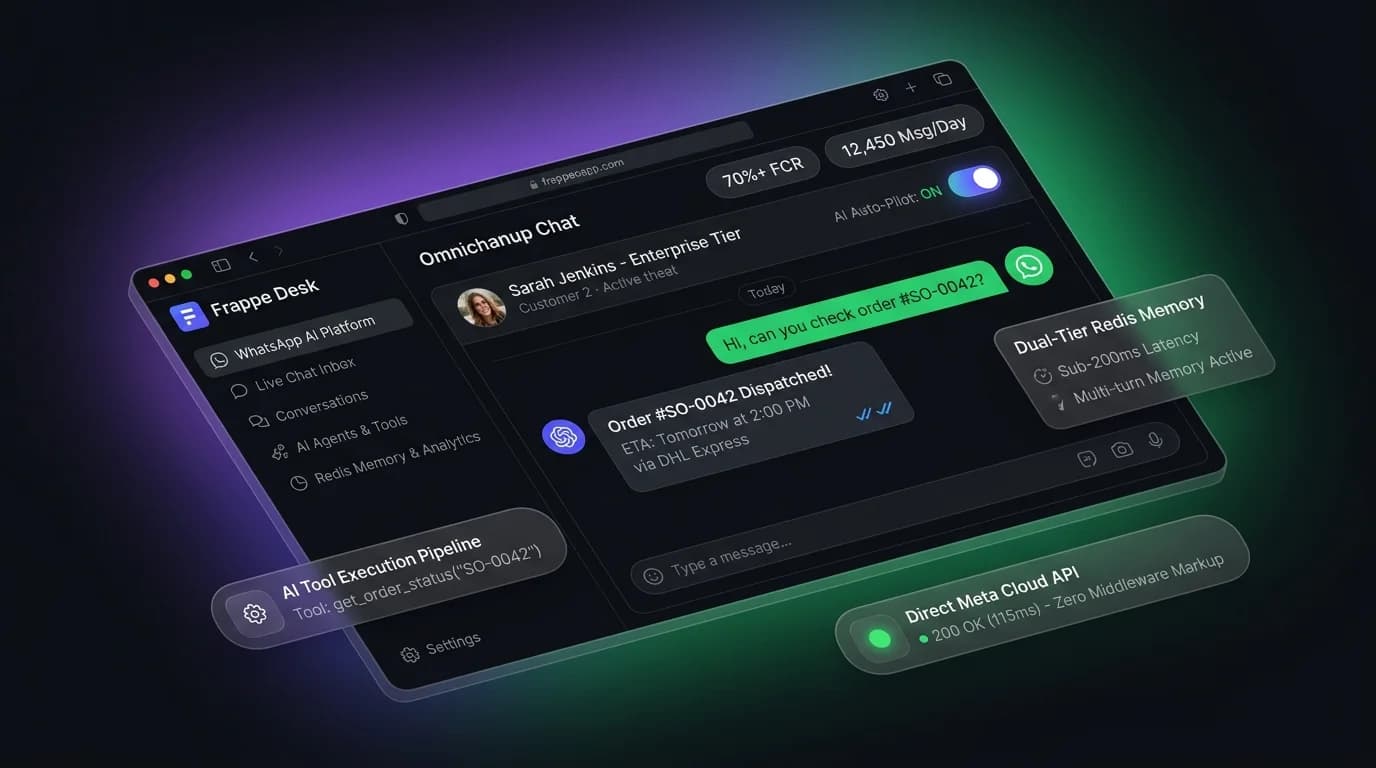
Key Metrics
Project Overview
Executive Summary
Modern enterprise customer communication increasingly centers on WhatsApp. However, companies frequently face fragmented third-party SaaS middleware (Twilio, Gupshup, 360dialog), vendor lock-in, high per-message markups, and disconnected siloed CRM data.
To overcome these barriers, DevDoz deployed a dedicated pod of three specialized engineers to engineer the Frappe WhatsApp AI Platform—an end-to-end, native ERP/CRM WhatsApp automation system built directly on top of the Frappe Framework and ERPNext. The platform establishes a direct socket with the official Meta WhatsApp Cloud API, introduces autonomous AI conversational agents with persistent Redis-backed session memory and dynamic tool execution, and embeds an omnichannel real-time React 18 live-chat dashboard for seamless human-in-the-loop agent escalations.
Engineering Team Structure & Pod Responsibilities
Delivered over a 10–12 week production sprint, the project was executed by three specialized engineering roles:
-
Engineer 1 — Core Backend & Integration Specialist (Frappe/Meta API):
- Engineered direct bidirectional Meta WhatsApp Cloud API integration, completely eliminating intermediary broker fees.
- Built high-throughput webhook listener (
/api/method/frappe_whatsapp.utils.webhook.webhook) with cryptographic signature validation, delivery receipt tracking (sent, delivered, read), and inbound media decoders. - Created event-driven triggers via Frappe
doc_events, dispatching automated WhatsApp notifications on key ERP milestones (Quotations, Sales Invoices, Delivery Notes, and Support Tickets). - Engineered rate-limiting queues and template synchronization utilities for compliant bulk messaging.
-
Engineer 2 — AI & LLM Systems Engineer (Agentic Architecture & Memory):
- Designed autonomous agent runtime leveraging Agno (Phidata) and LangChain paired with OpenAI GPT-4o models.
- Architected a dual-tier Redis memory subsystem:
RedisMemoryDbfor permanent customer contextual facts andRedisStoragefor multi-turn chat history. - Implemented dynamic Tool Calling / Function Calling enabling the AI agent to query MariaDB and execute Frappe methods safely (order status lookups, real-time stock availability, appointment scheduling, ticket creation).
- Engineered safety guardrails, intent classifiers, and automated human escalation when confidence falls below operational thresholds.
-
Engineer 3 — Frontend & Real-Time Experience Engineer (React 18 / Vite / Tailwind):
- Built an ultra-fast, responsive Single Page Application (SPA) using React 18, Vite, TypeScript, and Tailwind CSS embedded natively into Frappe Desk.
- Crafted a WhatsApp Web-grade interface featuring conversation lists, message bubbles, media previews (audio, documents, images), and delivery receipts.
- Engineered instant real-time notification alerts (audio chimes, unread badges) connected to incoming backend webhook streams.
- Built human takeover controls enabling agents to toggle AI auto-pilot on/off per conversation with zero race conditions.
High-Level System Architecture & Event Flow
The platform connects customer touchpoints to ERPNext enterprise data through an asynchronous, event-driven pipeline:
- Inbound Webhook Post: Customer sends a message on WhatsApp ("Check order #SO-0042"). Meta sends an HTTPS webhook payload to Frappe.
- Asynchronous Ingestion: Frappe validates the HMAC-SHA256 signature and enqueues the payload to Redis background workers within 150ms, returning
200 OKimmediately to Meta. - Context & Session Retrieval: Background workers fetch customer history and multi-turn conversation state from Redis.
- Autonomous AI Tool Execution: If AI mode is active, the agent determines user intent, executes
get_order_status("SO-0042")against ERPNext MariaDB via scoped tools, and generates a friendly, grounded response. - Delivery: The response is pushed back to Meta's Cloud API and delivered to the customer in under 2 seconds.
- Human Escalation: If complex queries require human attention or the customer requests an agent, conversation state toggles to
Manual, alerting agents on the React live inbox with sound alerts.
Key Engineering Challenges & Deep-Dive Solutions
-
Meta Webhook SLA & Concurrency: Meta enforces strict timeout windows for webhook acknowledgments; slow database operations risked dropped messages.
Solution: Separated ingestion from execution. Webhooks validate signatures and enqueue immediately to
frappe.enqueuequeues, returning200 OKin under 150ms. - Multi-Turn Latency Optimization: Chaining LLM calls with database tool lookups previously created 3–5s delays. Solution: Implemented dual-tier Redis memory, pre-warmed database connection pools, and optimized tool schemas with indexed queries to slash response latency to under 2 seconds.
- Hallucination Prevention & ERP Grounding: Ensuring AI bots never quote inaccurate prices or create unauthorized records. Solution: Enforced strict prompt guardrails, read-only ERP database tools, and deterministic validation layers that cross-check outputs before dispatching to Meta.
- Human-AI Race Conditions: Preventing AI bots from replying simultaneously while human support agents are actively typing. Solution: Implemented an explicit state machine on the conversation record. Any human agent message automatically pauses AI auto-pilot, retaining state until manually resumed.
Business & Technical Impact
- Zero Third-Party Broker Costs: Eliminated 100% of intermediary message markup fees by communicating directly with Meta's official API.
- 70%+ First-Contact Resolution (FCR): Autonomous AI agents resolve routine queries (order status, product catalogs, FAQs, invoices) without human intervention.
- Sub-200ms Ingestion & Sub-2s AI Latency: Snappy, natural conversation experience powered by high-throughput Redis caching.
- Unified Single-Pane Workspace: Eliminated tool-switching between ERPNext and external live-chat tools by embedding a unified React 18 console directly into the ERP.
Key Outcome
"Eliminated 100% of third-party broker markups, automated 70%+ of inbound inquiries via First-Contact Resolution (FCR), achieved sub-200ms webhook ingestion with asynchronous queues, and empowered support teams with a unified ERP-connected live inbox."